NORTH SAN ANTONIO — Two homeowners with similarly valued houses in North San Antonio can receive property tax bills that differ by hundreds or even thousands of dollars each year, largely because of school district boundaries and special taxing jurisdictions.
Property taxes in Bexar County are not determined by a single government agency. Instead, homeowners pay taxes to multiple entities, including Bexar County, the City of San Antonio, the Alamo Colleges District, University Health, the San Antonio River Authority, and their local school district. The combined rate can range from roughly 2% to 2.5% of a home’s taxable value depending on location.
For many North Side neighborhoods, the biggest difference comes from which school district serves the property.
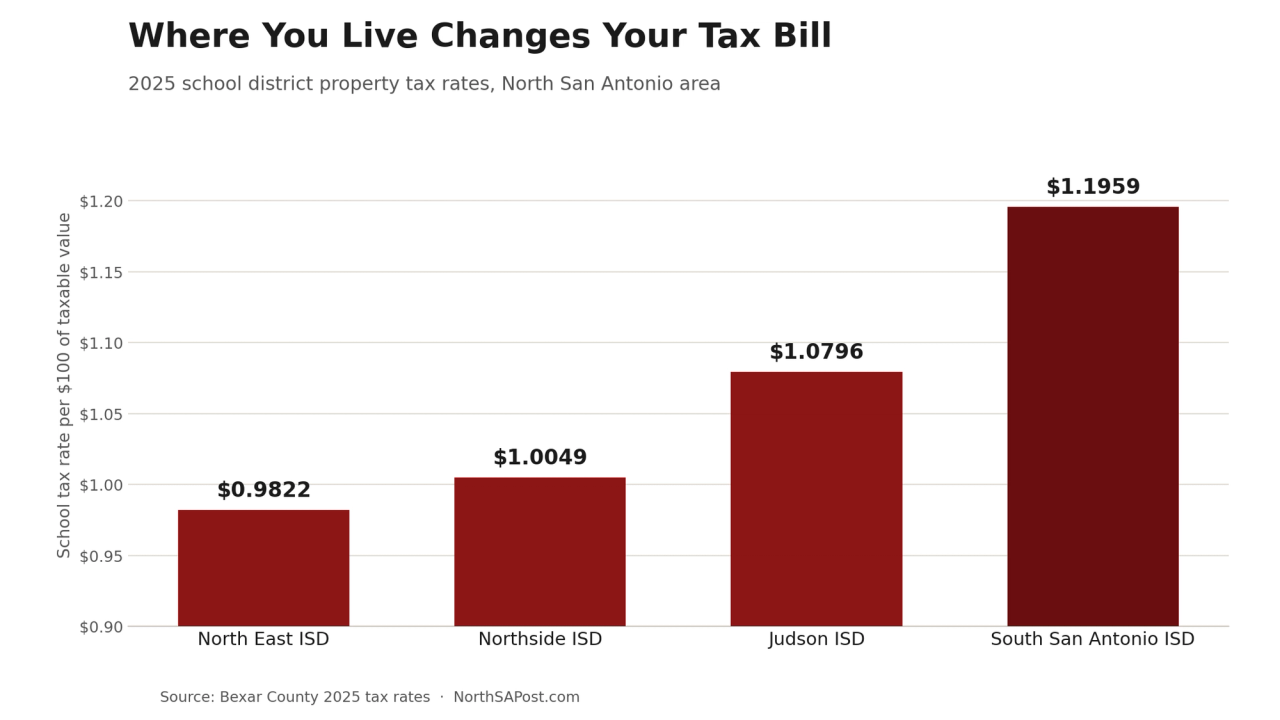
According to published 2025 tax rates, homeowners in North East ISD face a school tax rate of approximately $0.98 per $100 of taxable value, while residents in Northside ISD pay about $1.00 per $100. Other districts serving portions of the San Antonio area have significantly higher rates, including Judson ISD at roughly $1.08 and South San Antonio ISD at nearly $1.20 per $100 of value.
The difference may appear small, but it adds up. On a home with a taxable value of $400,000, a school tax rate that is 20 cents higher per $100 can increase annual taxes by approximately $800.
Neighborhoods in Stone Oak, Encino Park, and many areas along U.S. 281 are primarily located within North East ISD, while communities along the Interstate 10 corridor, Alamo Ranch, Helotes, and much of the city’s northwest side fall within Northside ISD. Homebuyers often focus on home prices and school quality, but tax rates can be an equally important factor in affordability.

Another key distinction is whether a property lies within additional taxing districts. Some rapidly growing suburban areas in northern Bexar County and neighboring counties are located inside Emergency Services Districts, Municipal Utility Districts, or Public Improvement Districts. These jurisdictions levy additional taxes that can increase a homeowner’s annual bill.
The growth of North San Antonio has also shifted the property tax landscape. New subdivisions in areas such as Bulverde Road, Cibolo Canyons, and the far northwest side continue adding taxable value to local governments’ tax rolls. County officials have noted that new construction remains a significant source of revenue growth even as home value appreciation has moderated from the rapid increases seen earlier in the decade.
Homeowners have received some relief through Texas homestead exemptions, which reduce the taxable value used for school taxes. Recent state changes increased those exemptions, helping offset tax burdens for many owner-occupied homes.
Real estate professionals say prospective buyers should examine not only a home’s price but also its effective tax rate before making a purchase. A house in one North San Antonio subdivision may carry a noticeably different annual tax burden than a similar home just a few miles away because of school district and special district boundaries.
As North San Antonio continues to expand, those tax differences are likely to remain a major factor influencing where families choose to live and how much they ultimately pay to own a home.
Sources: Tax rates are drawn from the Bexar County 2025 tax rate report and individual school district filings.